

The pill is not a medical detail. It is one of the technologies that have most redistributed power over time — time to study, to work, to choose a pregnancy… and, downstream, time to meet someone.
This is neither a nostalgic ode to “before”, nor a hymn to progress without a price tag. It is a reading in two movements: what it opened, and what it shifted.
We draw on French legislative history, Claudia Goldin and Lawrence Katz’s economics, and INSEE demographic series — distinguishing correlation, mechanism and multiple causes.
Landmarks: a revolution that took time
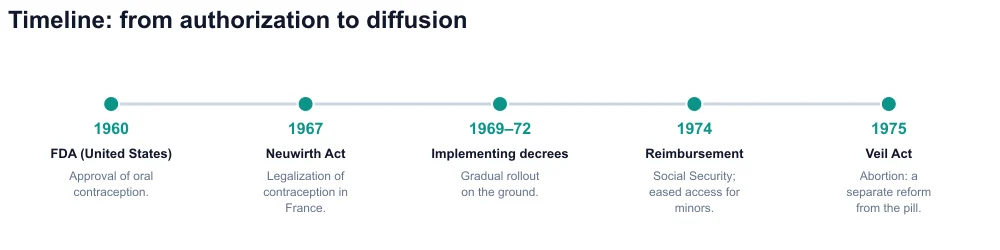
In the United States, the Food and Drug Administration approved oral contraception in 1960. Diffusion among married women was rapid; among young unmarried women it depended more on age-of-majority and access laws — a central point in Goldin and Katz’s work.
In France, Act No. 67-1176 of 28 December 1967 — the Neuwirth Act — legalized contraception and repealed the 1920 ban. Lucien Neuwirth framed what was at stake: moving from “accidental motherhood” to motherhood that is “conscious and fully responsible”.
Liberalization was not instant. Implementing decrees stretched from 1969 to 1972. The Act of 4 December 1974 opened Social Security reimbursement and eased access for minors in family-planning centers. Abortion is another text: the Veil Act of 17 January 1975.
Why these dates matter: without reliable, effective contraception, the risk of unintended pregnancy raises the cost of a long educational or professional investment. With it, that cost falls — not magic, an economic mechanism.
The timeline below fixes useful landmarks for what follows — without conflating contraception and abortion, or legal diffusion and social diffusion.
Verified landmarks. Social diffusion (information, cost, norms) often lags the law — hence the importance of decrees and reimbursement.
Sources: FDA (1960); Act No. 67-1176 of 28 December 1967; Senate / Neuwirth archives; Act of 4 December 1974; Veil Act of 17 January 1975.
What it opened: certainty, schooling, careers
Claudia Goldin and Lawrence Katz, in “The Power of the Pill” (Journal of Political Economy, 2002), show a dual effect in the United States among college-graduate women.
Direct effect: by sharply reducing uncertainty around unintended pregnancy, the pill lowers the cost of investing in long programs (medicine, law, MBA…). You can plan a career path without each sexual relationship putting the whole project at stake.
Indirect effect — the “social multiplier”: by encouraging delayed marriage in a generation, the pill widens the pool of still-single partners after professional school. Delaying is less costly on the marriage market.
Their empirical strategy exploits variation in state laws (age of majority, “mature minor”) that opened access for young unmarried women in the late 1960s. Career timing, age at first marriage and pill access move together — not a single proof, a serious causal collage.
In France, the “contraceptive revolution” documented by INED/INSEE/INSERM (surveys from 1971 to 2000) shows the rise of the pill as a dominant method among young women — as age at first marriage and first birth were already rising. The pill is not the only cause; it is an accelerator of chosen calendars.
What to keep without slogans: real reproductive autonomy. The ability to sequence schooling and early career. The ability to decouple sexuality from immediate parenthood. These are historical gains — measurable in women’s trajectories.
What it shifted: delay, selection, asymmetry
Opening an option also shifts the center of gravity of milestones. When pregnancy is no longer the dominant risk of each relationship, couple formation and childbearing can be postponed — sometimes willingly, sometimes by inertia, sometimes for lack of a partner at the “right” time.
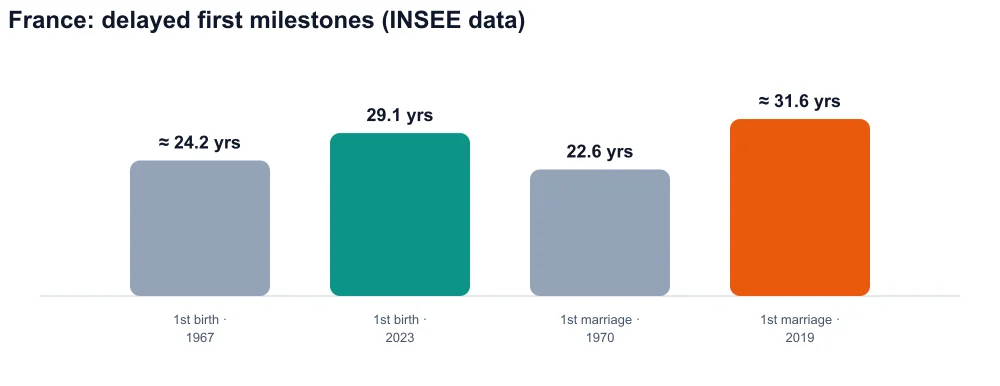
France figures (INSEE Focus No. 356): in 2023, the mean age of mothers at first birth reaches 29.1 years — 5.1 years later than in 1974, and 4.9 years later than in 1967. Delaying the first child then shifts later births.
On marriage (INSEE first-marriage series): mean age of women at first marriage rises from about 22.6 in 1970 to 25.6 in 1990, then 30.0 in 2010 and about 31.6 in 2019. Since 2023 INSEE no longer publishes this indicator in the same form (series break on marital status) — hence caution on the latest years.
Calendar asymmetry: oral contraception widely democratized control over conception timing… while leaving intact the biological asymmetry of fertility with age. You gain social time; you do not gain unlimited biological time. Not a moral lesson — a physiological constraint demographers and clinicians have documented for decades.
Later selection: as schooling and careers lengthen, matching happens more often among already advanced profiles (degrees, income, values). Sociologists talk about educational homogamy and assortative mating. That is not “the pill’s fault” alone — it is a package: pill + mass schooling + labor market.
The chart below summarizes two French series: age at first birth (INSEE) and age at first marriage for women (INSEE, through 2019).
Age at first birth: about 24.2 in 1967 → 29.1 in 2023 (INSEE Focus 356). Mean age of women at first marriage: 22.6 (1970) → about 31.6 (2019). The pill coexists with these trends; it is not the sole cause.
Sources: INSEE Focus No. 356 (2025); INSEE demographic reports (female first marriage). Age at first marriage: last comparable published year ≈ 2019.
Neither nostalgia nor myth: reading costs without caricature
The nostalgic temptation says: “before, people married earlier, families held together.” It forgets unintended pregnancies, blocked careers, power asymmetries, clandestine abortions. The pill reduced concrete suffering.
The progressive temptation says: “everything is better thanks to technology.” It forgets that delaying is not always choosing. An open calendar can become a blurry calendar: “later” with no criterion, no conversation, no meeting.
Contemporary demography adds context: the total fertility rate falls to 1.62 children per woman in France in 2024 (INSEE Première No. 2033) — historically low outside world wars. Blaming “the pill” alone would be simplistic: housing, precarity, norms, desire for children, task-sharing and couple formation enter the equation.
What economic research can say without excess: oral contraception changed the relative price of time. It made long human-capital investment more rational. It also made it easier to defer commitment — which, in aggregate, transforms meeting markets.
The “deep values” many still declare (fidelity, family, children — World Values Survey and national surveys) do not magically vanish. What changes is the path to get there: longer, more individual, less mapped out by extended family or neighborhood.
What this changes for meeting someone today
When “get engaged at 22” scripts thin out, frames still need to be invented. Apps offered an unlimited market; they did not solve shared time or presence.
Asymmetric calendars: one person may want to build now; another “after the permanent job / after the trip / after the thesis”. Without a shared language of tempo, the relationship wears down in unspoken tensions — a topic we have explored elsewhere in the Journal.
Homogamy and late selection: the longer you wait, the more you filter. Understandable. It can also produce loneliness: “ready” profiles that never cross paths off-screen.
The contemporary paradox: never has contraception given so much control over fertility — and never has couple formation seemed so uncertain for part of the population. The problem is not “too much freedom”; it is the lack of places and rituals to turn freedom into connection.
Daremeet sits here: not as a demographic fix, but as a bridge toward real-world meetings — challenges, places, presence — when calendars are long and scripts are thin.
What to keep without a slogan
The pill opened: reproductive autonomy, long schooling, professional careers, sexuality decoupled from immediate parenthood.
It helped shift: age at couple formation and childbearing, later matching, more heterogeneous individual calendars — in a cocktail of causes (school, work, norms, housing).
This is not a condemnation of contraception. It is an invitation to treat relational time as a scarce good: technology lengthened the social window; it did not invent for us the courage to meet.
If you are building a life project as a pair — or even a solid friendship — the question is not “for or against the pill”. It is: how do we sync free calendars without letting them evaporate.
Conclusion
Oral contraception is a gain in autonomy — documented by law, economics and demography. It also redistributed the tempo of lives: more options, fewer scripts.
Neither a step backward nor a denial of costs: the contemporary challenge is to rebuild ways of choosing each other when “later” has become the default norm.
Less virtual, more presence: it is in that interval — between contraceptive freedom and the desire for connection — that real meetings regain meaning.
Want real-world meetings?
Daremeet offers challenges and frames to cross paths outside infinite feeds — without selling you a character, and without dictating a life calendar.
Find more investigations and analyses on the Daremeet Blog.