

You didn’t “lack confidence.” They sold you a character to play — and you ended up believing you were the problem.
In forty-five seconds, a coach promises: be harder, rarer, more dominant, less available. Change the costume, win the game. Often you leave with a mask — and a finer anxiety.
This piece unpacks the business of the replacement personality: what they sell, why it works, what research says about the ideal self and controlled motivation — without demonising all help, and without offering a new Daremeet script.
What they really sell: a ready-made identity
The catalogue is familiar: the detached one, the alpha, the “king of my time,” the inaccessible woman, the calibrated soft girl, the emotionless cold approach. Archetypes. Costumes.
The mechanism is simple. Vague diagnosis (“you’re too nice,” “too intense,” “too available”) → spectacular solution → masterclass or subscription. They steal an everyday word, then sell you a posture.
They are not selling maturity. They are selling a replacement personality: a role that promises to erase rejection by changing your face.
Short format speeds the sale. No room for nuance. Just contrast: before (you, “broken”) / after (you, “upgraded”). Transformation becomes a product.
Link to our kindness piece: same factory. A specific behaviour (boundaries, passivity, hidden expectations) is confused with an entire identity — then they sell the opposite costume.
Why it works — and what the psychology of the self says
Shame plus hope: a purchase cocktail. You can “progress” without ever meeting anyone. And if it fails, they say you didn’t apply the method hard enough — they never say the method is wrong.
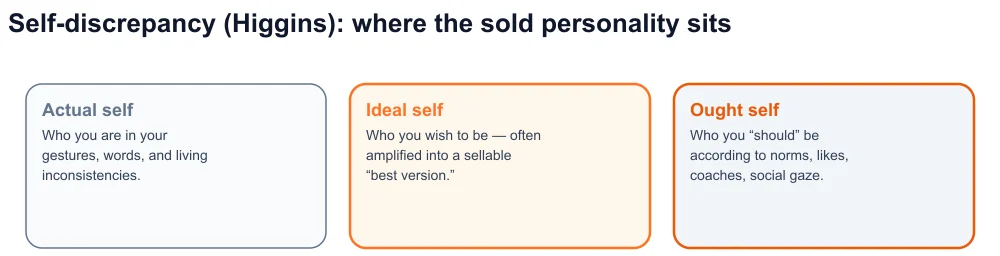
In psychology, E. Tory Higgins formulated self-discrepancy theory: we hold an actual self, an ideal self (who we wish to be), and an ought self (who we should be according to norms). The larger the gap, the more negative affect rises — anxiety, dejection, agitation.
Viral coaching industrialises that gap. It inflates the ideal self (“high-value you”) and the ought self (“what people respect”), then sells the bridge. Too often the bridge is a mask — not integration.
They monetise your doubt, not your connection. A bought personality does not survive three minutes over a coffee, a silence, or someone simply asking: “and you — what do you like?”
The diagram below summarises Higgins’s idea: three self-representations — and where the “sold personality” typically sits.
The actual self is what you live. Ideal and ought selves are projections — often inflated by self-help marketing. The gap feeds negative affect; selling a role promises to close it without knowing you.
Source: Higgins, E. T. (1987). Self-discrepancy: A theory relating self and affect. Psychological Review, 94(3), 319–340.
Sold personality vs real presence
They sell a script. A meeting asks for presence. Not the same thing.
Useful mental table: calculated scarcity ≠ clear availability. Dominance / mystery ≠ honesty + boundaries. Performance ≠ coherence. The other person is not a jury — unless you make them one.
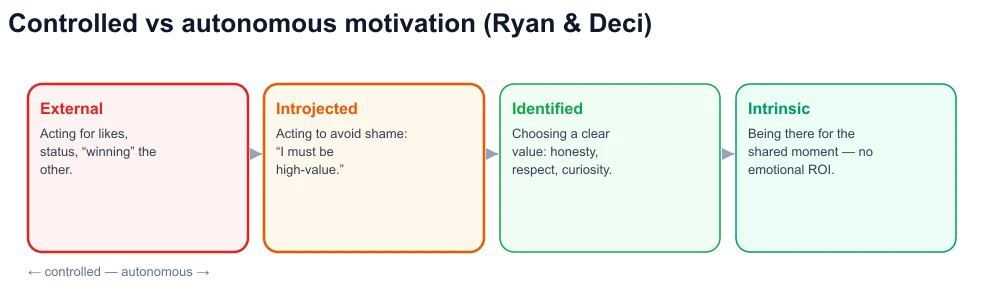
Self-determination theory (Ryan & Deci) distinguishes more controlled motives (external pressure, shame, “I must be…”) from more autonomous motives (integrated value, intrinsic interest). Viral coaching often pushes toward control: become someone to get a result.
A real encounter rewards autonomy more: being there because the moment matters — not because a character must “close.”
The continuum below shows where the viral promise typically sits — toward external and introjected regulation — versus more autonomous motivation.
The more regulation is external or introjected (shame, “I must look high-value”), the more fragile the behaviour. Lasting relational presence leans on more autonomous motives.
Source: Ryan, R. M., & Deci, E. L. (2000). Self-determination theory and the facilitation of intrinsic motivation, social development, and well-being. American Psychologist, 55(1), 68–78.
This is not a condemnation of all help. Therapy, serious coaching, self-work: useful when they help you know yourself. Toxic when they ask you to perform to “win” at dating.
The hidden cost of the mask
You no longer know what you like. You score the other person like a jury. You’re afraid of silence — because there’s no punchline.
You confuse authenticity with an “optimised version of me.” Authenticity is not an inverted Instagram filter: it’s coherence between what you feel, say, and do — over time.
Self-presentation (impression management) is human: we always adjust the social face a little. The problem starts when the adjustment becomes the product — and the self disappears behind the pitch.
In friendship as in romance, the mask tires both sides. The other senses the gap. You feel the emptiness after the performance.
Useful line: if your meeting has an ROI, it isn’t a meeting anymore — it’s an audit.
What we don’t say (nuance)
Seeking help is not weakness. Many people followed coaches because they were truly suffering — loneliness, rejection, confusion.
The red line: they sell you an identity, not skills. “Learning to say no” is not the same as “becoming another person.”
We are not offering a Daremeet counter-character. No “be authentic in 7 days.” Just a question: can you be there, without a costume?
Recovering presence — without a new script
Spot the mask: which sentence do you repeat that isn’t yours?
Replace the role with a simple intention: “I want a real moment.” Choose a setting where the mask weighs less — place, challenge, shared activity.
Accept being average, alive, imperfect. That’s already rarer than the character. And it’s the only material from which a real relationship can be built.
Conclusion: they didn’t sell you confidence
They sold you a replacement personality. Alpha, mystery, high-value: costumes for a market that monetises doubt.
The real question isn’t “which version of me performs better?” It’s: can I be there, readable, without a costume?
Real encounters don’t reward the best role. They reveal who remains when the script stops.
Try another way
Download Daremeet, pick a challenge and a place, and create a moment where you don’t need a character — just presence.
Read more Journal articles