

Perhaps nothing is more exhausting, day to day, than living with things left unsaid. Not peaceful silences—those where you understand each other without needing to verbalize everything. The other kind: sentences you hold back, hurts you minimize, disagreements you bury "so as not to make waves." You tell yourself you're being kind. That you're protecting the other person. That you're preserving harmony. Except that, by saying nothing, harmony becomes surface—and kindness, without you noticing, slides into complacency.
This article unpacks that mechanism in three contexts where silence hurts most: seduction (not saying what you feel for someone), friendship, and work. We show how avoidance can destroy everything—sometimes before a bond even begins—and how kindness slides into complacency when we confuse apparent peace with honesty. Finally, we suggest concrete paths toward more truthful speech, especially during in-person meetups.
Who this is for: anyone who feels they're "locking away" important things, fears hurting someone by speaking, or notices relationships going in circles despite the apparent absence of conflict.
Anatomy of the unsaid: what we don't say and why
An unsaid thing is not simply a secret. It's information, a feeling, or a need that exists—sometimes for a long time—but finds no outlet. "I don't like it when you do that, but it's no big deal." "That hurts me, but I don't want to ruin the evening." "I'd like something else, but I don't want to seem demanding." Each phrase seems reasonable. Together, they build an architecture of silence.
Unsaid things take several forms. Pure avoidance: changing the subject, postponing, hoping "it will pass." Minimization: turning a real need into a "detail." Politeness pushed to the extreme: smiling, nodding, letting the other person believe all is well. Indirect complaint: venting to a third party rather than the person concerned. Digital ghosting: disappearing without explanation—the ultimate form of the unsaid.
The causes are many. Fear of conflict. Fear of rejection. An upbringing in "politeness" that confuses harmony with absence of friction. Fatigue—you no longer have the energy for another round. Sometimes, bitter lucidity: "What's the point of talking, it won't change anything." That last case is often a sign the unsaid has already done its work: you no longer believe speech serves any purpose.
What makes unsaid things so insidious is that they make no noise. No slammed door, no shout. Just distance settling in, humour dulling, intimacy contracting. You can live together, work together, see each other regularly—and yet no longer say what matters.
The harm of the unsaid is not spectacular. It is cumulative. It erodes trust, feeds unfounded interpretations, and gradually turns the other person into an enigma—or even a potential threat, since you no longer know what they really think.
One and the same avoidance logic, by rising intensity: the further down, the sharper the breakdown in communication.
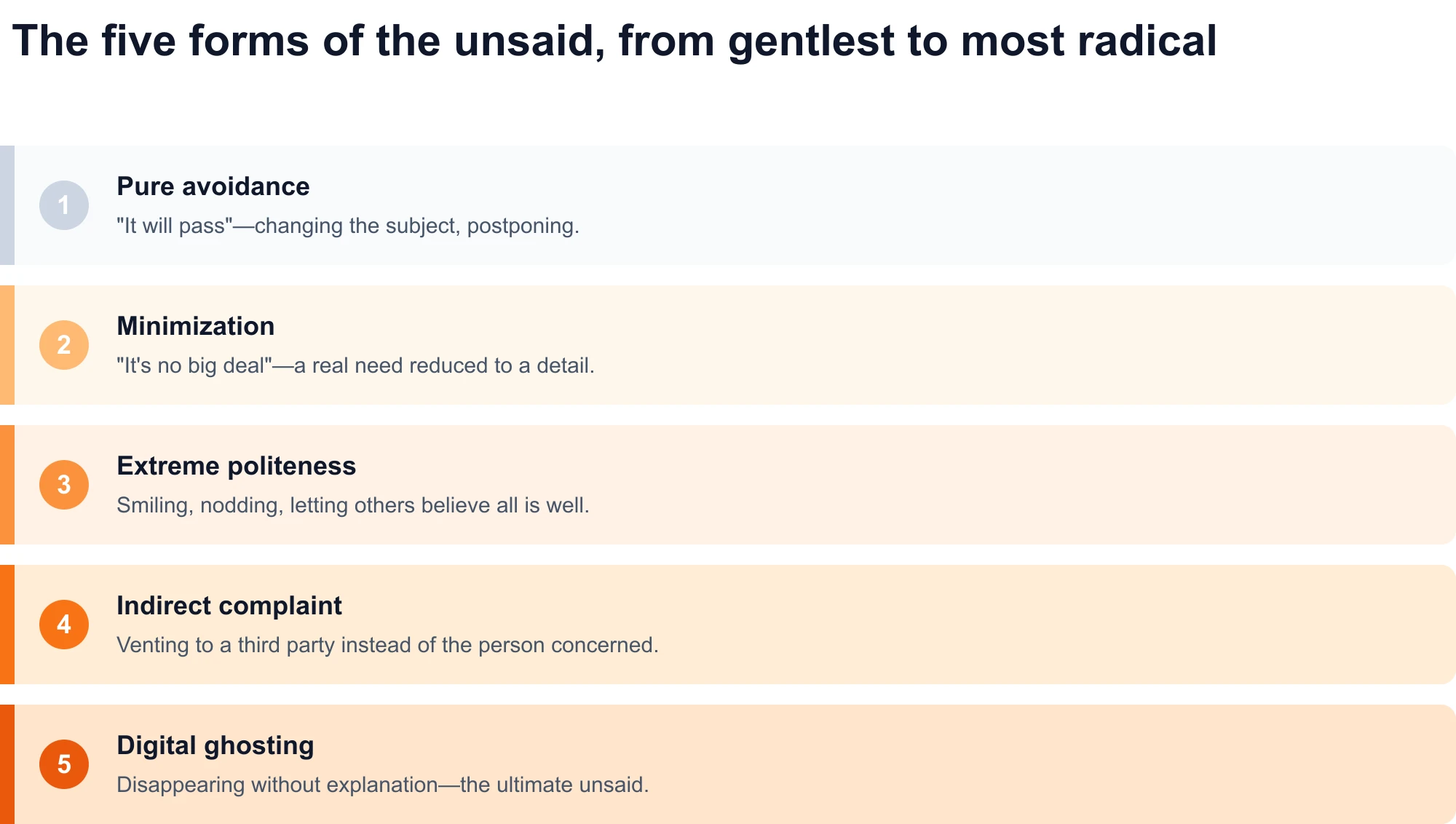
Typology drawn from the mechanisms described in this article (relationship psychology, nonviolent communication).
Kindness and complacency: the fading boundary
Kindness, in the strong sense, seeks the other's good—and sometimes that means saying a disturbing truth, with tact and at the right moment. "I love you enough to tell you this behaviour hurts me." "I want our relationship to last, so I need us to talk about this." Kindness is not the absence of friction: it is the presence of real care that refuses to let what could still be repaired rot.
Complacency, by contrast, mainly seeks to preserve immediate comfort—yours or theirs. You avoid the topic "so as not to upset them." You validate without conviction. You accept compromises that, repeated, become resentment. Complacency mimics niceness: it says yes, smiles, and puts things off. But it builds nothing solid, because it rests on an edited version of reality.
The slide is gradual. At first, an occasional unsaid can seem like a gesture of gentleness. Then it becomes a habit. Then an implicit norm: in this relationship, we don't talk about that. You end up confusing apparent peace with real peace. Yet peace without speech is often a truce—fragile, and costly for whoever accumulates what they haven't said.
Complacency sometimes has a short-term protective function: it avoids an argument, discomfort, humiliation. But long term, it impoverishes the bond. The other person cannot truly know you if you don't give them access to what you're going through. And you cannot know them if you interpret their silences instead of asking questions.
Recovering authentic kindness means relearning that telling the truth respectfully is not attacking—and that staying silent is not always protecting. It's a demanding balance, requiring courage, timing, and sometimes the humility to admit you contributed to the silence.
In seduction: not saying what you feel can destroy everything
The seduction phase may be when unsaid things do the most damage—because everything is still fragile, and every signal counts. You're attracted. You think about the other person. You imagine what could come next. And yet you say nothing—or almost nothing. You play detached. You wait for them to guess. You tell yourself that admitting your feelings is "too much," "too soon," "too heavy." You prefer hints, reactions to stories, ambiguous messages that can always be walked back with "I was joking."
That silence is not neutral. The other person interprets. They wonder if they misread the signals. If they're getting ahead of themselves. If they're the only one who feels something. Without clear words, each person builds their own version—often the worst one. Meanwhile, the window closes: the other pulls back, meets someone else, or concludes "it's not mutual." It's not always a romantic tragedy: it's often a misunderstanding born of silence.
Not saying what you feel can destroy a story before it begins. Not because the truth would have guaranteed success—rejection is part of life—but because the unsaid prevents any clear outcome. You stay in an exhausting in-between: close enough to hurt, not honest enough to move forward. Months can pass like this. Sometimes years. And when you finally speak, it's too late—or the bond was built on mutual complacency that never dared name desire, fear, or expectation.
Seduction doesn't need grand speeches. It needs sincere words, at the right moment, respecting the other person's pace. Saying "I'm glad to see you," "you interest me," "I'd like to see you again," "I can't imagine living without you" is not an attack—it's giving the other person a real basis to respond. Rejection, when it comes, hurts; but it hurts less than drawn-out ambiguity. And welcome, when it comes, starts on something true—not on a mask of false indifference.
This is especially true during in-person meetups—where you see each other, share a moment, where body language and eye contact already convey something messages cannot. Daring to name what you feel, in the moment or just after, can change a relationship's trajectory. Not doing so sometimes means letting the only chance you had slip away.
Friendship, work, and screens: the same poison of silence
In friendship, the unsaid often sounds like "all is well" when you feel neglected, judged, used, or simply less important than before. You don't dare say: "the way you spoke hurt me," "I need to see you more," "I care about you and I'm afraid we're drifting apart." You fear seeming heavy, jealous, or "too much." So you stay quiet. The friendship continues on the surface—messages, likes, occasional outings—but empties of substance. And one day, without clear explanation, you're no longer really friends. Each wonders what happened. The answer, often: things that were never said.
At work, unsaid things poison differently—but with the same logic. You don't say you're overwhelmed. That you disagree in a meeting. That a remark was hurtful. That you deserve recognition you're not getting. You smile, nod, "manage." For fear of conflict, judgment, career impact. Except silence accumulates into fatigue, cynicism, avoidable errors. Teams that go in circles without ever naming real problems end up losing their best people—not because of drama, but because of years of small unsaid things that smothered trust.
Screens amplify these dynamics. In seduction as in friendship, you can reply later, choose your words, disappear, leave on "seen." Ghosting—cutting contact without explanation—is the extreme form of the digital unsaid: you erase the other rather than saying "this isn't for me" or "I need space."
Share of U.S. adults reporting they experienced ghosting in a dating context, per a survey conducted in August 2023. Ghosting is cutting off all contact without explanation.
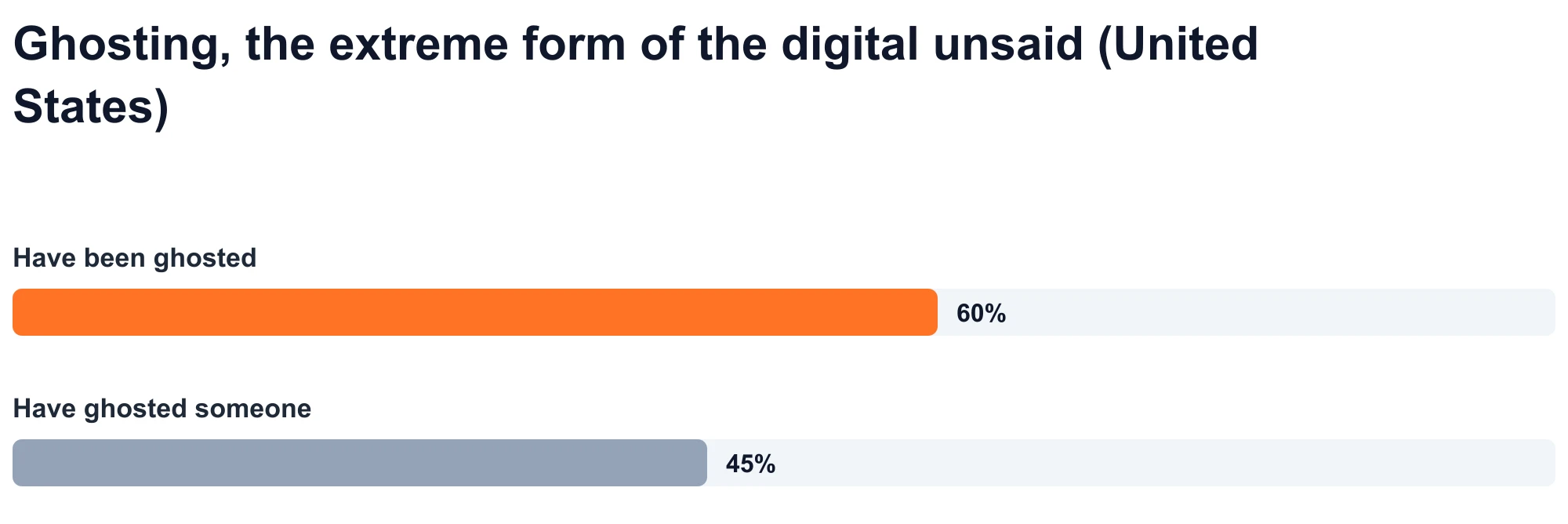
Source: Statista survey, August 2023 (5,000 U.S. adults).
Light reactions (emoji, like, short message) can give the illusion of a maintained relationship while no substantive topic is addressed. Online dating multiplies micro-unsaid: disappearing instead of explaining, dragging out a conversation with no real intent, saying "let's meet soon" without ever proposing a date. Each avoidance seems minor. Together, they create a culture where engaging speech—saying what you feel, want, or refuse—is the exception.
This isn't a blanket condemnation of digital life. It's an observation: interfaces that lower the cost of avoidance favour avoidance. Recovering more honest speech often passes through contexts where avoidance is harder—where you see each other, share a moment, where silence weighs differently.
Recovering real speech: small steps, framework, presence
Getting out of unsaid patterns doesn't mean dumping everything at once. Fear of spiralling often maintains silence. Starting small helps: one honest sentence on a less threatening topic, factual feedback ("when you do X, I feel Y"), an open question ("what do you really think?").
Framework matters. Talking in a calm place, when you have enough time, changes the game. Important conversations held standing in a hallway or by voice note at midnight are more likely to go wrong. The physical world offers cues: you see the other person's reaction, can adjust, pause, and return.
This is where a logic like Daremeet's can make sense—not as therapy, but as a facilitator of presence. A meetup in a public place, around an activity, creates a situation where speech can emerge naturally—including in seduction, where daring to say "you interest me," "I'd like to see you again," or "I can't imagine living without you" sometimes takes less courage in person than online. The body is there. Context is shared. You can't simply put the phone face down and pretend all is well.
Recovered kindness also passes through listening. Saying what you feel serves little if the other has no space to respond. Sometimes the first unsaid to lift is this one: "I need us to talk for real. Are you available for that?"
Finally, accept that not every relationship will survive the truth. Some complacency maintained an artificial form of bond. Saying what you feel can reveal deep disagreement—and that hurts. But it is often less destructive, long term, than letting silence poison everything without anyone understanding why.
Caution, safety, and what not to say
Naming unsaid things is not an injunction to say everything, all the time, to everyone. In contexts of power imbalance, violence, or manipulation, direct speech can be risky. Caution is not complacency: it is survival.
There are also things we choose not to share—legitimate intimacy, privacy, topics too heavy for a first date. The line between healthy secrecy and toxic unsaid often comes down to emotional charge: does this silence eat at me? Am I protecting the other, or avoiding my own discomfort?
Daremeet reminds users of respect and consent in all interactions—including when a challenge leads you to speak to someone. A compliment or invitation must remain respectful of the other's receptivity. Saying what you think does not mean imposing your presence or opinion.
Conclusion: real gentleness is not silence
Unsaid things promise peace. They often deliver distance, resentment, and exhaustion. In seduction, not saying what you feel can destroy a story before it begins. In friendship or at work, the same silence can empty a bond over years—without any open conflict explaining the break.
True kindness dares to speak. Complacency chooses comfort. Between the two lies a demanding path—of small gestures, favourable settings, courage, and listening. A path where the physical world, presence, and shared time become allies again.
If this article helped you name what you were living, it has done its job. The next step isn't necessarily a grand declaration. Sometimes it's simply a sentence you wouldn't have dared say yesterday—said today, with respect.
Want to meet in the real world, with more presence?
Download Daremeet, choose a challenge and a place, and create moments where speech can emerge naturally—at your pace, in a clear and respectful framework.
Find more investigations and analysis in the Daremeet Blog.