

"What's your body count?" The question keeps coming up in TikTok street interviews, among friends, sometimes on early dates. Literally "body count," the term refers to how many sexual partners someone has had. For part of Gen Z, that number has become a marker — of reputation, experience, "purity," or performance.
It is not harmless. In late March 2026, Ifop and retailer Espaceplaisir published a survey on sexuality among French women aged 15–29: 70% feel that a high body count tends to devalue a woman in society — a "social gaze," the study notes, more than a private opinion. The press, including Midi Libre, has collected testimonies from young adults who say they "have to" wonder about it, lie about the number, or feel "attacked" when their intimacy is questioned.
This article explores the phenomenon without moralism or scoreboards: where the obsession with the number comes from, how sex was progressively uncoupled from reproduction — and, for many people, from commitment and fidelity — and why treating it as consumption still disconnects us from the body and the bond.
Body count: where the word comes from, and why it exploded
Body count emerged in Anglophone online culture — forums, rap, memes — before spreading to TikTok and Instagram. Creators stop strangers in the street: "What's your body count?" Reactions — embarrassment, laughter, outrage — fuel millions of views. In the comments, discourse flares up: glorifying low numbers for women, admiration for high numbers among men.
For part of Gen Z (people born between 1997 and 2012), body count is no longer only private: it is a topic of conversation, sometimes an implicit compatibility criterion. Students interviewed by Midi Libre say it is a question you "have to" ask yourself. Others prefer learning "over time." Some do not want to "know what happened in the past" before committing.
The phenomenon also affects men. A 24-year-old craftsman says he feels "attacked" when his intimacy is questioned; he prefers talking about "sexual experience" rather than a number. A 25-year-old woman remembers the topic coming mainly "from men she dated, like a competition or proof of performance."
What changes with social media, observes sexologist Charlotte de Buzon, is scale: intimate information becomes public content, judged by thousands of strangers. Body count is no longer only a curiosity among close friends: it is an algorithmic trend.
Understanding this virality does not mean legitimizing it. It means recognizing that a number — arbitrary, often lied about, impossible to verify — occupies a disproportionate place in contemporary dating culture.
What Ifop measures: a social gaze, not a private opinion
The Ifop / Espaceplaisir survey (published late March 2026, French women aged 15–29) documents a climate: 70% feel a high body count devalues a woman in society. The authors specify that this figure mostly reflects perceived external judgment — not necessarily each respondent's personal conviction.
The double standard is massive and longstanding, but it is reshaped on social media. Charlotte de Buzon summarizes: a woman who "accumulates conquests" is slut-shamed; a man is put on a pedestal. The same behaviors receive opposite labels by gender — a historically entrenched cliché, amplified by public visibility.
This social gaze pushes lying on both sides. A 22-year-old history student observes: "Guys with a low body count inflate the number to look better. Girls with a high body count reduce it so they don't come across as easy." Trimming body count is not new, notes the sexologist — especially in school, where "you have to fit the norm to avoid harassment."
An 18-year-old summarizes the taboo on the feminine side: "For many girls, it's taboo." On the masculine side, discomfort exists too — but sometimes translates into inflating the number rather than silence. In both cases, truth yields to social performance.
Citing Ifop does not mean “society is right” to judge. It means many young people already live under that gaze — before even choosing their own values. And counting others' partners, or one's own, reproduces that tribunal.
Ifop sample: 1,011 women, online questionnaire 23–27 January 2026. Nearly one in four (24%) says a man has already refused to commit after learning of a body count judged to be high. At the same time, 70% say they could enter a relationship with a man who has a high body count — the double standard also lives in that gap: we fear for ourselves what we tolerate in the other.
Women aged 15–29 living in metropolitan France. The 70% “devaluation” figure mostly measures perceived outside judgment — not necessarily each respondent’s private opinion.
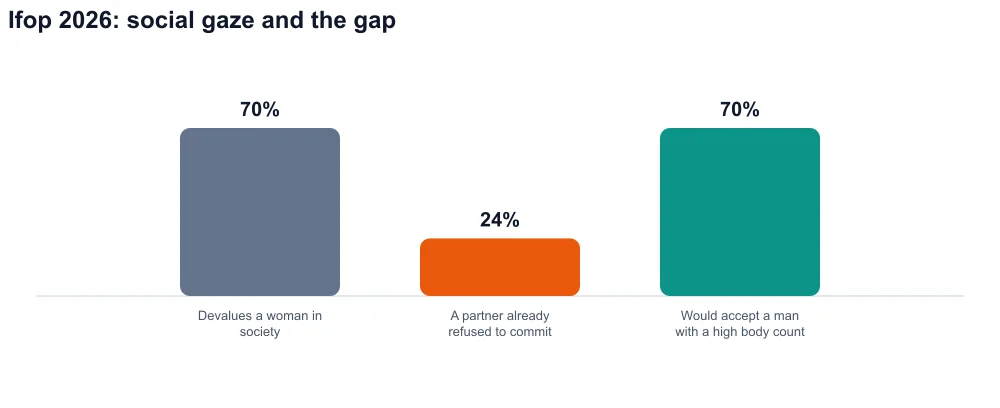
Source: Ifop for Espaceplaisir, Gen Z sexual behavior observatory, 23–27 January 2026, n = 1,011.
Sex uncoupled: reproduction, couple, fidelity

Body count only became a social language in a world where sex was first detached from having a child — then, for a growing share of people, from the couple and from fidelity. Sociologist Anthony Giddens called this “plastic sexuality” (1992): sexuality that can unfold without reproduction. That is not a moral opinion. It is a technical, legal and cultural transformation, in successive layers.
The first layer is pregnancy risk. The contraceptive pill (France’s Neuwirth Act, 1967) opened a sexuality whose outcome is no longer “necessarily” a child — we traced that in our Journal article on the pill. Emergency contraception (NorLevo over the counter from June 1999; free with no age condition since 1 January 2023) adds an after-the-fact safety net. Abortion, distinct from contraception, is another layer: 251,270 procedures in France in 2024, or 17.3 per 1,000 women aged 15–49 (DREES). Access to these tools is a health right. They also change the perceived cost of an encounter: the sex → child link is no longer automatic. It is not zero either — hence 34.7% of the most recent pregnancies over five years were described as “unwanted” in CSF-2023, and 51.8% among women aged 18–29.
The second layer is the couple. Dating apps separated sex from a two-person project. In CSF-2023, 17.9% of women and 23.7% of men aged 18–69 have already met a sexual partner via a site or app — around 40% among people in their thirties. Having several partners in the last 12 months, among 18–29-year-olds, rose from 9.6% (1992) to 23.9% (2023) for women, and from 22.9% to 32.3% for men. That is not “everyone lives this way.” The point is that, for a growing share, the act no longer implies commitment, or even exclusivity.
Body count as a word only takes off in that landscape: a world where sex became, for many, countable — because it was detached from the child, from marriage, sometimes from fidelity. Sexuality surveys measure this without judging it. Women aged 18–69 report 7.9 lifetime partners on average in 2023, versus 3.4 in 1992; men, 16.4 versus 11.2. The gender gap remains wide — partly because people do not report the same way.
Averages among people aged 18–69 who have ever had sex. The gender gap is old and partly due to reporting (people do not tell the same story).
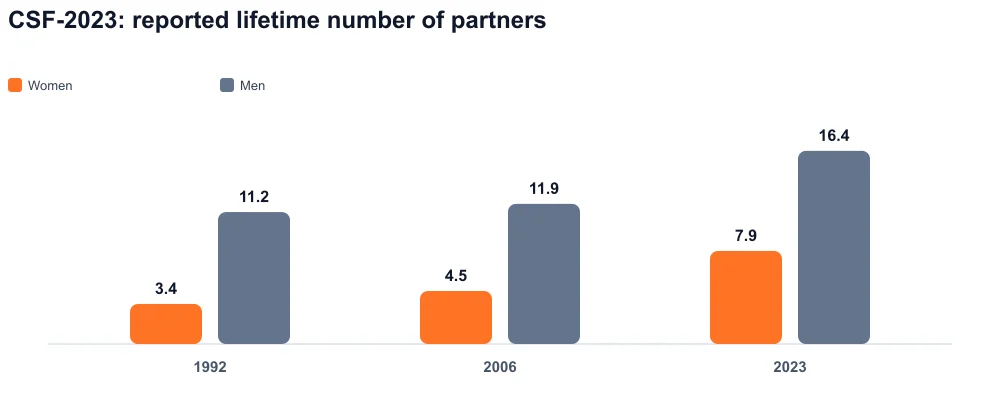
Source: ACSF-1992, CSF-2006, CSF-2023, Inserm / ANRS-MIE. Scope: ages 18–69 who have already had sexual intercourse.
This uncoupling does not erase biology. Heterosexual intercourse still carries procreative potential: pregnancy can occur even with contraception. For a woman, each partner is also, symbolically, someone with whom that risk exists — and with whom she shares deep physical intimacy. Pregnancy develops in her body; a man does not bear the same direct consequences.
Research in social neuroscience (oxytocin, attachment — effects vary by person) suggests the body does not “forget” as easily as a swipe. On the masculine side, body count often feeds comparison and fear about exclusivity. Listening to that asymmetry is not “going backward,” nor judging anyone who used emergency contraception or had an abortion. It means refusing to treat intimacy as a product that now has no cost — when the cost has mostly changed shape.
Consumption logic: when the other becomes a product
Body count turns people into dashboard rows. We "consume" encounters like content: chain them, compare, move on without digesting. This logic is close to what we described elsewhere on cardinal individualism and personality sold by viral coaching: the other becomes audience, trophy, or obstacle.
Dating apps amplified this reflex — stacked profiles, decisions in seconds, illusion of infinite choice. Body count is the extreme version: an intimate KPI. But KPIs say nothing about the quality of the connection, consent, respect, shared pleasure, or pain felt.
"Gaming the system" — lying, inflating or shrinking one's number, playing a role — means bypassing one's own relational nature to fit an external norm. We protect an image, not a truth. And we prevent the other from truly knowing us.
Charlotte de Buzon sees in glorifying digital "purity" a form of extremism: a "respectable" woman would be one with few or no partners — a submissive, obedient redefinition compatible with TikTok comments. Conversely, glorifying a high male body count pushes performance without attachment. Two cages.
Stepping out of consumption does not mean imposing abstinence on everyone. It means asking a simple question: am I treating this person as a body to add to my counter, or as a being with whom I choose — or not — to share something?
Psychological and physical consequences
Psychologically, obsession with body count fuels anxiety, shame, and retroactive jealousy. Some avoid promising relationships for fear of judgment. Others engage in encounters they do not truly want in order to "catch up on" a number perceived as too low or too high. Lying about one's past — frequent, according to press testimonies — corrodes trust from the first weeks.
Sexual health research also reminds us of physical risks when multiplying partners without appropriate prevention: sexually transmitted infections (STIs), screening to schedule, sometimes consequences for fertility. This is not divine punishment: it is medical reality that public health campaigns regularly recall — regardless of moral judgment.
Over time, chaining encounters without an emotional bond can produce a form of numbness — less openness to emotional connection, less patience for the slow pace of a real bond. Once past adolescence, notes Charlotte de Buzon, many are no longer in performance mode — but social media keeps broadcasting a teenage norm of competition.
These effects do not touch everyone the same way. The issue is not stigmatizing an active, consensual sex life. It is recognizing that body and mind are not indifferent machines when it comes to numbers — especially when the number becomes a social weapon.
If you recognize distress linked to intimacy, judgment, or peer pressure, speaking to a professional (doctor, psychologist, family planning) is an act of care — not weakness.
Now what: what to look at instead of the number?
Replace "how many?" with "how?": do I feel respected? Could I say no? Do I understand what I seek — pleasure, a relationship, exploration, waiting — without comparing myself to others' scores?
Body count does not predict future fidelity, partner quality, or compatibility. Two people with a discreet past can treat each other badly; two people with long histories can build something solid — if communication, consent, and respect are central.
Refusing to play the counter is also respect for the other: not reducing their history to a number, not demanding an inventory as a condition for affection. Some things are shared when trust is there — not under pressure from a street interview or a first drink.
Conclusion: sex is not a score
Body count has become a social language — fed by TikTok, Ifop, the CSF survey, fears of commitment, and persistent double standards. It promises a numerical truth about intimacy; it mostly delivers lies, shame, and comparison. It only makes sense in a world where sex was first detached from having a child, then often from the couple.
Recognizing both this historical uncoupling and the biological dimension that did not vanish — without prudery or condemnation — helps step out of consumption logic. The other is not a product to rate; they are a person with whom one chooses, or not, to draw closer.
Less courtroom, more presence: perhaps the only metric still worth something.
Want to meet differently?
Daremeet offers challenges and frameworks to meet in real life — without scoreboards, without endless swiping: a place, an activity, a possible conversation.
Find more investigations and analyses on the Daremeet Blog.