
You say you're "organic", you watch what you eat — and yet you sometimes feel flat, irritable, or disconnected from your body. It's not "all in your head": a growing body of research documents how endocrine disruptors (EDCs) — present in cosmetics, food packaging and the environment — interfere with the hormones that regulate energy, mood, libido and cycles.
This is neither an anti-cosmetics pamphlet nor a guilt-driven lecture on food. It's a reading in two registers: what studies show (with their limits), and what it can concretely change when you're trying to meet people — in real life, with energy and presence.
We rely on peer-reviewed reviews (Frontiers, Springer Nature, Chemosphere), national cohorts (NHANES, Korean surveys), and ANSES syntheses — distinguishing association, biological mechanism and multiple causes.
Landmarks: endocrine disruptors, an invisible bath
Endocrine disruptors (EDCs) are substances — natural or synthetic — that can mimic, block or disrupt hormone action. They often act at very low doses, and above all in mixture: parabens + phthalates + bisphenols + triclosan, etc.
Exposure routes are multiple: skin (cosmetics, sunscreens), ingestion (food, plastic packaging), inhalation (perfumes, aerosols). WHO and national health agencies classify them among major environmental risks for reproductive and metabolic health.
The most documented chemical families in everyday products: parabens (preservatives), phthalates (often hidden in fragrances under "parfum" or "fragrance"), bisphenols A/F/S (food packaging, receipts), triclosan (antibacterial), benzophenones (UV filters).
Mechanisms: these molecules can bind to estrogen, androgen or thyroid receptors — altering hormonal signaling without producing the same response as a natural hormone. Cumulatively, they can disrupt the hypothalamic-pituitary-gonadal (HPG) axis, central to reproduction and the menstrual cycle.
Crucial point for what follows: exposure is not the same for everyone. It depends on the number of products used, diet, biological sex, age and sensitive periods (puberty, pregnancy, menopause).
Cosmetics and personal care: documented exposure
Skincare and beauty products are a direct, repeated exposure route. A review in Reviews in Endocrine and Metabolic Disorders (2025) catalogues the effects of cosmetic EDCs — parabens, phthalates, triclosan, benzophenones — on skin, reproductive and hormonal health.
Women statistically use more product categories than men: makeup, creams, perfumes, cleansers, hair products. A Korean national survey (2015–2017, n = 5,962) shows that as the cumulative number of products used increases, urinary paraben concentrations (methyl-, ethyl-, propyl-) increase significantly.
In the United States, NHANES 2005–2006 (general population) measures markedly higher urinary paraben concentrations in women than in men. Researchers attribute this gap mainly to more frequent use of personal care products — lotions, cosmetics, perfumes.
Among pregnant women followed at a fertility clinic (Boston), use of lotion, makeup and perfume/cologne in the 24 hours before urine collection is associated with 111% to 167% increases in certain EDC biomarkers — a dose-response relationship with total number of products used (Journal of Exposure Science & Environmental Epidemiology, 2014).
Documented effects on female reproductive health include: irregular cycles, polycystic ovary syndrome (PCOS), endometriosis, reduced ovarian reserve, thyroid disorders, and fertility changes — according to a Frontiers in Endocrinology review (2023) and a synthesis on declining female fertility (2024).
This is not a condemnation of beauty or self-care. It's an exposure fact: the more products you use, the higher the cumulative dose — and studies show skin is not a sealed barrier.
Adjusted odds ratios for urinary methylparaben (MP) and propylparaben (PP) concentrations above the 95th percentile. Women have about 3.2 times higher odds of being in the highest exposure band for MP, and 4.2 times for PP — mainly linked to personal care product use.

Source: Calafat, A. M., et al. — Urinary Concentrations of Four Parabens in the U.S. Population: NHANES 2005–2006. Environmental Health Perspectives, 2010. Daremeet editorial chart.
Even "organic" cosmetics: reduce, not eliminate
Many switch to "natural", "organic" or "paraben-free" thinking they eliminate risk. Science is more nuanced: certified organic reduces exposure — especially to pesticides, synthetic parabens and synthetic fragrances — but does not guarantee zero EDCs.
A study in Chemosphere (2022) analyses conventional and "green" products (labels "bio", "paraben-free", "silicone-free", "100% natural origin"). Result: parabens are detected in products that do not always list them as ingredients; the cumulative effect of several "clean" products remains concerning for total exposure.
A Frontiers in Public Health review (2026) examines side effects of toxic or restricted substances in cosmetics declared "of natural origin". Conclusion: "natural" marketing is not enough; risk substances (allergens, disruptors, lightening agents) persist in a non-negligible share of reported products.
Certifications (COSMOS Organic, ECOCERT, Natrue) impose allowed ingredient lists and organic origin thresholds — but rely mainly on manufacturer documentation, not systematic laboratory testing of finished products. Independent analyses (2025) show "phthalate-free" products sometimes contain detectable phthalates anyway.
Plant extracts themselves can contain bioactive compounds (phytoestrogens) or pesticide residues — "organic" sources are not always free of environmental contaminants (Cosmetics, 2024).
Takeaway: "organic" = likely lower exposure, not absence of risk. The issue is reducing product count, choosing credible certifications, and scepticism toward unverified claims ("clean beauty" without third-party label).
Diet and ultra-processed food: a second hormonal channel
Diet affects hormones through several mechanisms: caloric and glycemic intake (insulin), chronic inflammation, gut dysbiosis — and EDC exposure via packaging, additives and processing contaminants.
Ultra-processed foods (UPFs) — industrial, rich in added sugars, refined fats, emulsifiers — are associated with insulin resistance, low-grade inflammation and gut–liver–ovary axis disruption. For women with PCOS, several systematic reviews (2025–2026) identify high UPF consumption as a factor worsening hyperandrogenism and LH/FSH imbalance.
UPFs also introduce EDCs: bisphenols and phthalates migrate from plastic packaging into food. Cohort studies show that as the share of UPF in the diet increases, urinary concentrations of phthalate and bisphenol metabolites increase — including in pregnant women.
A Frontiers in Nutrition narrative review (2026) notes that UPFs can disrupt estrogenic, androgenic and glucocorticoid pathways independently of caloric excess — via inflammation, mitochondrial function and combined chemical exposure.
NHANES cross-sectional study (1,974 women, 2013–2016): high exposure to bisphenol A, bisphenol F/S and triclosan is associated with lower SHBG (sex hormone-binding globulin), obesity and metabolic syndrome — with effects modulated by menopausal status.
Simplified diagram of documented routes. Exposure is cumulative: cosmetics + food/packaging + indoor air. No single channel explains observed imbalances — it's the sum that counts.
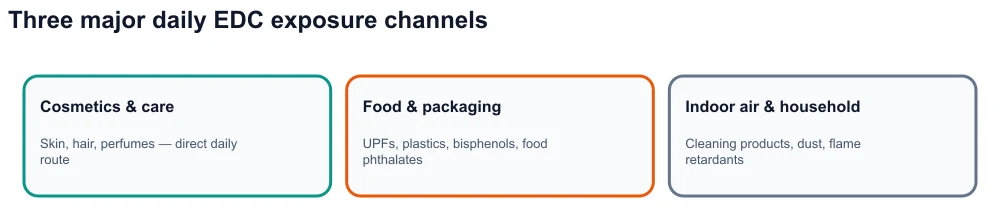
Source: editorial synthesis from Dodson, R. E., et al. (2012), Environ Health Perspect; Frontiers in Nutrition (2026); ANSES — endocrine disruptors. Daremeet chart.
This is not a call to eat "perfectly". It's recognizing that ultra-processed food on your plate and plastic packaging are hormonal variables — often ignored when searching for the cause of fatigue or an irregular cycle.
Why women seem more affected — and where it gets complicated
On the reproductive axis — cycles, ovulation, fertility, PCOS, thyroid — women accumulate more risk factors: higher cosmetic exposure, more complex cyclic physiology, sensitive windows (puberty, pregnancy, menopause).
A review in International Journal of Molecular Sciences (2020) details EDC effects on female puberty: early or disrupted menarche, breast development, ovarian function. The HPG axis is particularly vulnerable during these periods.
Sex-specific mechanisms are documented: liver and adipose tissue metabolise EDCs differently by sex and hormonal status (HAL, 2021). Endogenous estrogens offer partial protection on some metabolic parameters — which changes the response to the same exposures.
But beware oversimplification: on other indicators (abdominal obesity, hypertension, fatty liver), some studies sometimes show a stronger association in men with certain EDCs (Nutrients systematic review, 2024). So it's not "women always more" on everything — it's more marked on reproduction, cycles and fertility.
Possible everyday consequences — without catastrophising: chronic fatigue, mood swings, lower libido, skin and hair changes, irregular cycles, difficulty concentrating. These symptoms have multiple causes; EDCs are one documented track, not the only one.
If you experience persistent symptoms (very irregular cycles, amenorrhoea, hirsutism, unexplained weight gain, severe fatigue), a gynaecologist or an endocrinologist is the right professional — not a blog article.
What it changes for meeting people — and practical steps
Hormones aren't an abstract topic when we talk about dating. They influence the energy available to go out, libido, body confidence, relational mood, patience with unspoken things — all variables that weigh on connection quality.
When the body is under chronic chemical and inflammatory stress, the biological priority is not "go meet someone" — it's to survive and recover. This isn't an excuse to isolate; it's context explaining why "just swipe more" solves nothing if the tank is empty.
Exposure reduction steps — without dogma: reduce the number of cosmetic products (less is more); favour recognised certifications (COSMOS, ECOCERT) over "clean" marketing alone; avoid undisclosed synthetic fragrances; limit UPFs in favour of raw or minimally processed food; reduce hot food–plastic contact (microwave, hot drinks in plastic).
On the dating side: relational energy is also rebuilt through sleep, movement, real social connection — not detox alone. Daremeet doesn't sell a lifestyle regime; it offers frameworks to meet when you want to be present.
The contemporary paradox: never have we had so much wellness information — and never has the everyday environment exposed our bodies to so many hormone-active molecules. Understanding this invisible bath isn't becoming paranoid: it's regaining leverage over what is modifiable.
Less screen, more presence: when the body feels better, meeting becomes an option — not a performance chore.
Conclusion
Cosmetics — including some "organic" products — and ultra-processed food contribute to documented exposure to endocrine disruptors. Women are statistically more exposed via personal care products, and more vulnerable on the reproductive axis.
This is neither a condemnation of progress, nor a return to idealised "all natural". It's an invitation to reduce what is modifiable — without guilt — and to consult a health professional when the body sends persistent signals.
Meeting in real life requires energy, curiosity and a certain inner availability. Taking care of your hormonal environment is also taking care of your capacity to create connection.
Want real-life dating?
Daremeet offers challenges and frameworks to meet outside infinite feeds — with body and mind available for connection, not performance.
Find more investigations and analyses on the Daremeet Blog.