

You hear it everywhere: "Stop being nice", "Nice guys finish last", "Be an alpha, not a nice guy". In forty-five seconds, a coach tells you your kindness is the problem—and thousands of comments agree. Except what they're describing is often not kindness at all. It's complacency, a lack of boundaries, or fear of rejection dressed up as softness. The word has been stolen. And that confusion costs dearly—in dating, friendship, and work.
This article unpacks the mechanism: why short-form content distorts words, what viral archetypes wrongly call "kind", and how to distinguish authentic kindness, complacency, and weakness. We also show what viral coaching gains from keeping the confusion alive—without putting all coaches on trial, or claiming that "being kind" solves everything.
Audience: anyone who has ever thought "I'm too nice", tried to "toughen up" because of social media, or feels their relationships lack clarity despite apparent softness.
What shorts call "kind" (and what it isn't)
On TikTok, Instagram Reels, or Facebook, a few archetypes keep coming back. The "nice guy" who expects a reward for every thoughtful gesture. The person who is "too nice" and supposedly has "no backbone". The false dilemma: kind on one side, alpha or respected on the other. The punchline: "Kindness is weakness."
This kind of content doesn't always criticise kindness in the strong sense. It often criticises a specific behaviour: lack of boundaries, hidden expectations, fear of conflict, saying yes to avoid discomfort. But it uses the wrong word—and the viewer leaves with a label ("I'm too nice") instead of a diagnosis ("I can't say no").
The "nice guy", in Anglo-Saxon culture, typically describes someone pleasant on the surface while harbouring implicit expectations—sometimes resentment if the other doesn't "give back". That's not kindness: it's a transaction disguised as softness.
Another frequent case: someone who postpones, validates without conviction, avoids uncomfortable topics "so as not to upset" anyone. They're called kind. Often it's complacency—a gesture that mimics benevolence without building a solid bond, as we described in our article on unsaid things.
The distortion starts here: a word for a human quality is recycled to mean everything you should leave behind—passivity, naivety, lack of boundaries. And people who are genuinely attentive, respectful, and clear end up doubting their own character.
Why short-form content distorts words
A short lasts forty-five to sixty seconds. You need to grab attention, create tension, offer a simple solution. The algorithm rewards polarisation, not nuance. Result: punchy lines ("stop being nice") replace fine distinctions ("learn to set boundaries without becoming cold").
Personal development and coaching vocabulary appropriates everyday words—kind, toxic, red flag, boundary—and gradually empties them of meaning. Everyone ends up speaking the same language without always sharing the same definition.
The viewer has no time to ask: "What exactly do you mean by kind here?" They retain the emotion—shame, urgency, promise of transformation—and the formula. That's effective for engagement. It's less effective for understanding your own relational life.
Coaches and content creators aren't all at fault: many do serious, long-form, nuanced work. This article targets viral coaching, short format, spectacular promises—not an entire profession.
Understanding this mechanism doesn't mean rejecting all self-reflection. It means recognising that some discourses benefit from making you believe your problem is called "kind"—when it might be called fear, complacency, or a need to be liked at any cost.
Kindness, complacency, weakness: three different things
Kindness, in the strong sense, combines care for the other and respect for yourself. It can say no. It can name discomfort. It doesn't expect a hidden reward. Example: "I care enough about you to say this behaviour hurts me"—with tact, at the right moment.
Complacency mainly seeks to preserve immediate comfort—yours or the other's. You avoid the topic, validate without conviction, say yes out of habit. It mimics kindness: it smiles, it postpones. But it builds nothing durable, because it rests on a sugar-coated version of reality.
Weakness, in the sense shorts use it, rather describes an inability to set boundaries—often from fear of rejection or conflict. It's not an identity: it's behaviour you can change, in small steps, without "stopping being yourself".
Classic model in assertiveness psychology (Alberti & Emmons, assertiveness training since the 1970s). True kindness belongs in the assertive register: you can be attentive and set boundaries. Complacency slides toward passive; "alpha" coaching toward aggressive.
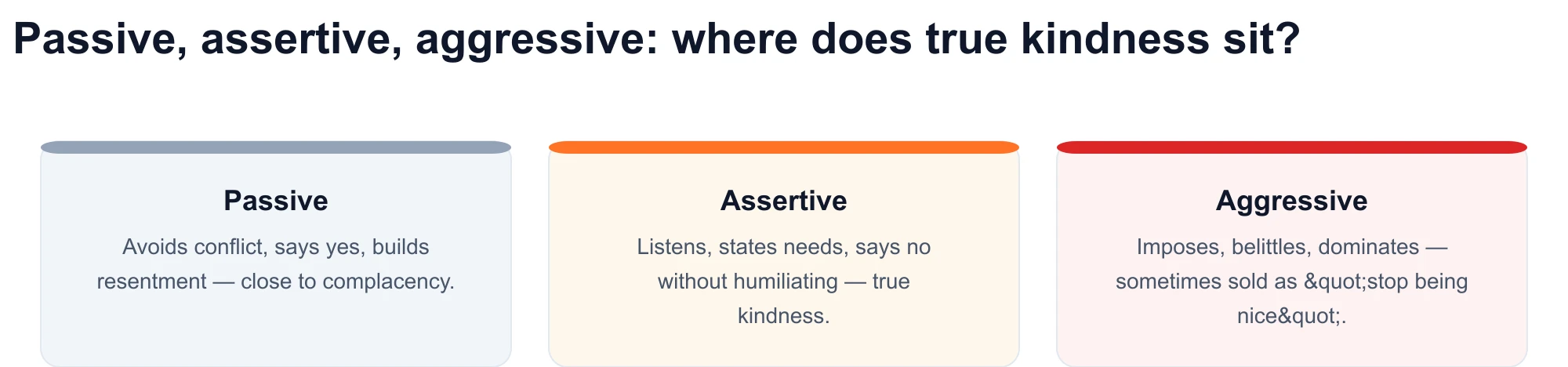
Source: Alberti, R. E., & Emmons, M. L. — passive / assertive / aggressive model in assertiveness training (Your Perfect Right, recent editions). Daremeet editorial diagram.
A useful mental table: true kindness includes honesty and sometimes disagreement; complacency avoids; weakness (in the viral sense) submits. Confusing the three means accepting being told to "stop being kind" when what you need is to be clearer.
In meta-analyses on the Big Five model, higher agreeableness (cooperation, empathy, trust) is associated with greater relationship satisfaction — not the opposite. This isn't identical to everyday "kind", but it contradicts the idea that "being nice" harms relationships. Malouff et al. (2010) find the same directional trend for partner-reported satisfaction.
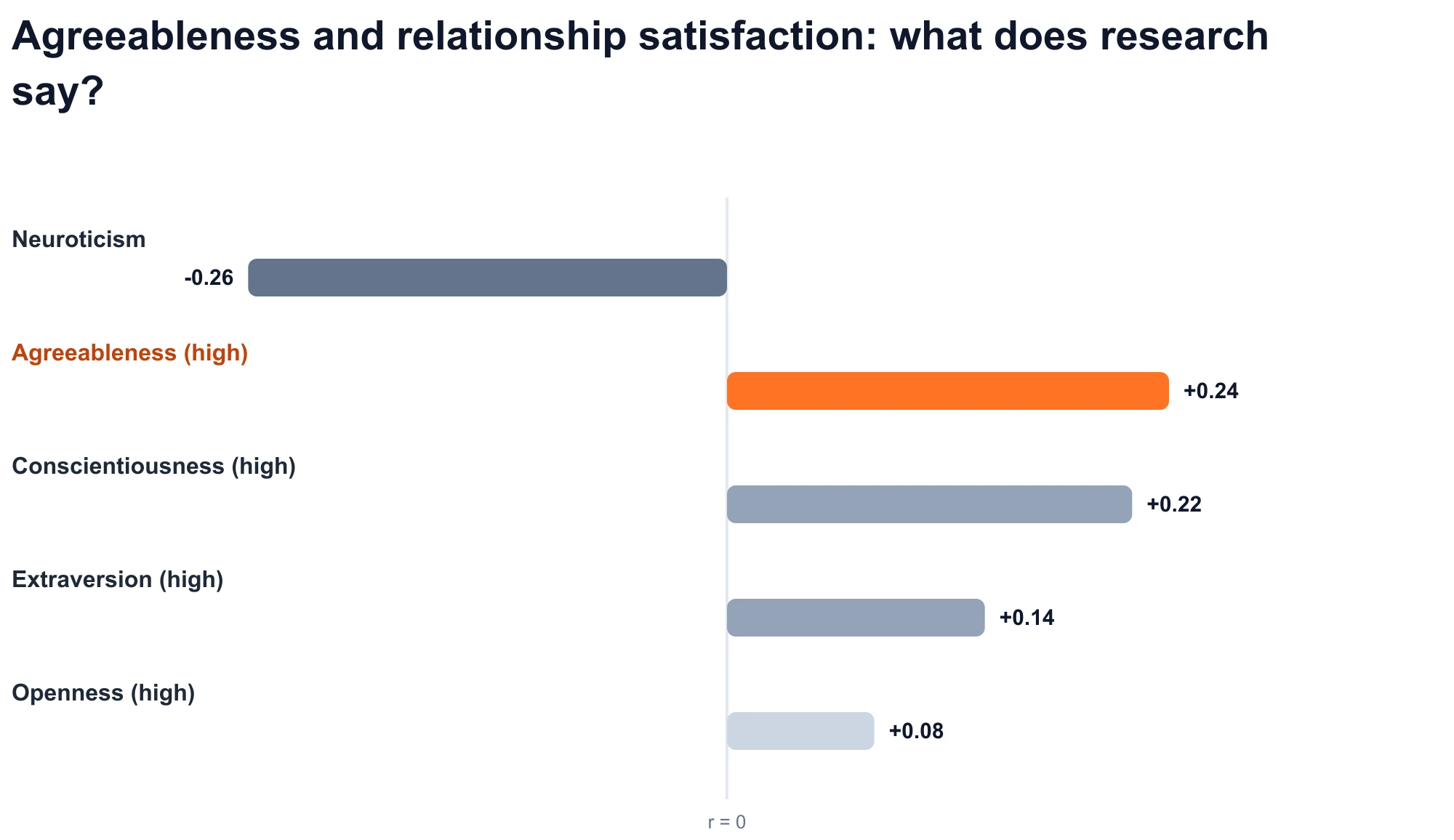
Source: r correlations (marital satisfaction meta-analysis) — Heller, D., Watson, D., & Ilies, R. (2004), Psychological Bulletin, 130, 574-600. Partner-rated confirmation: Malouff, J. M., et al. (2010), Journal of Research in Personality, 44(1), 124-127, doi:10.1016/j.jrp.2009.09.004.
Reclaiming the word means reclaiming a relational ambition: being present, respectful, able to say what you feel—without performing toughness, without waiting for the other to guess. Psychology distinguishes agreeableness (a relational strength) from submission (passive behaviour): shorts conflate them; research does not.
In other words: "stop being nice" often targets passivity or complacency. The solution isn't to become harsh—it's to learn assertiveness, which is compatible with kindness in the strong sense.
What viral coaching gains from confusing the terms
Selling a transformation ("go from nice to alpha") requires a simple, identifiable problem. If the problem is "you can't set boundaries", the solution is less spectacular than a full personality rebrand—but often more effective.
The dating and personal development market sometimes encourages performing a role: detached, mysterious, dominant, "high value". The other becomes coach, audience, or obstacle—a logic we also observed in cardinal individualism. Encounters are evaluated as investments with expected emotional return.
When you're told your kindness is the problem, you're often offered another mask—not more authenticity. Cold instead of clear. Calculating instead of sincere. Distant instead of setting boundaries with respect.
This isn't a condemnation of all outside help. Therapy, serious coaching, inner work: useful when they help you know yourself—not when they ask you to play a character to "win" at dating.
The real question isn't "am I too kind?" but "am I honest, reciprocal, and able to say what I want and what I refuse?"—three qualities compatible with kindness.
In dating and friendship: the cost of confusion
In dating, someone who forces themselves to "stop being nice" can become cold or enigmatic—then wonder why relationships don't last. Conversely, someone who stays "nice" in the complacent sense exhausts themselves without ever being truly known. Both suffer from the same ailment: speech not aligned with what they feel.
Saying "I'm glad to see you", "I'm interested in you", "I'd like to see you again" isn't being kind in the weak sense—it's offering a real basis to respond. Rejection hurts; prolonged ambiguity often hurts more.
In friendship, the same confusion turns listening into self-erasure—or "frankness" into brutality without empathy. True kindness holds between the two: it can say "that hurt me" without attacking, and "no" without justifying for ten minutes.
Screens amplify performance: you play the less-kind character, or stay in surface politeness. In-person meetings—a coffee, a walk, a shared activity—reintroduce salutary friction: the other is there. You can't optimise everything from your phone.
That's the spirit of Daremeet: creating contexts where performance fades, where you can be attentive without calculation—and clear without becoming someone else.
Reclaiming the word: small gestures of true kindness
Say what you feel, at the right moment—not all at once, but with progressive sincerity. Set a boundary without attacking: "I'm not available tonight", "This topic makes me uncomfortable, let's change it". Refuse politely without over-justifying.
Be attentive without expecting a reward: a message because you're thinking of the other, not to trigger an owed reply. Distinguish legitimate protection from systematic avoidance: staying silent to "not make waves" isn't kindness.
Choose contexts where the social mask weighs less—in-person meeting, shared activity, clear framework. Kindness matures over time; it's built with someone, not in a monologue about yourself in front of a camera.
If you've long believed you're "too nice", perhaps start with another question: "What am I afraid to say—and why?" The answer will tell you whether you need less softness, or more courage.
Real courage today may not be becoming less kind—it's daring to stay human in a world that tells you it's a weakness.
Conclusion: kindness doesn't need rehabilitating—it needs to be named correctly
On social networks, the word "kind" has been tarnished by confusing it with everything it isn't: complacency, passivity, hidden expectations. Shorts and part of viral coaching benefit from keeping that confusion—because it sells spectacular transformations.
Authentic kindness includes honesty, boundaries, sometimes disagreement. It's not the absence of character—it's the presence of care, for the other and for yourself. Reclaiming this word means reclaiming a relational quality that real-world encounters often reward better than performance.
If this article resonates with you, the first step may not be a new character. It's truer speech—and the decision not to let an algorithm define who you should be.
Want to meet without playing a role?
Download Daremeet, choose a challenge and a place, and create moments where true kindness—attentive, clear, without calculation—can simply exist.
Find more investigations and analysis in the Daremeet Blog.